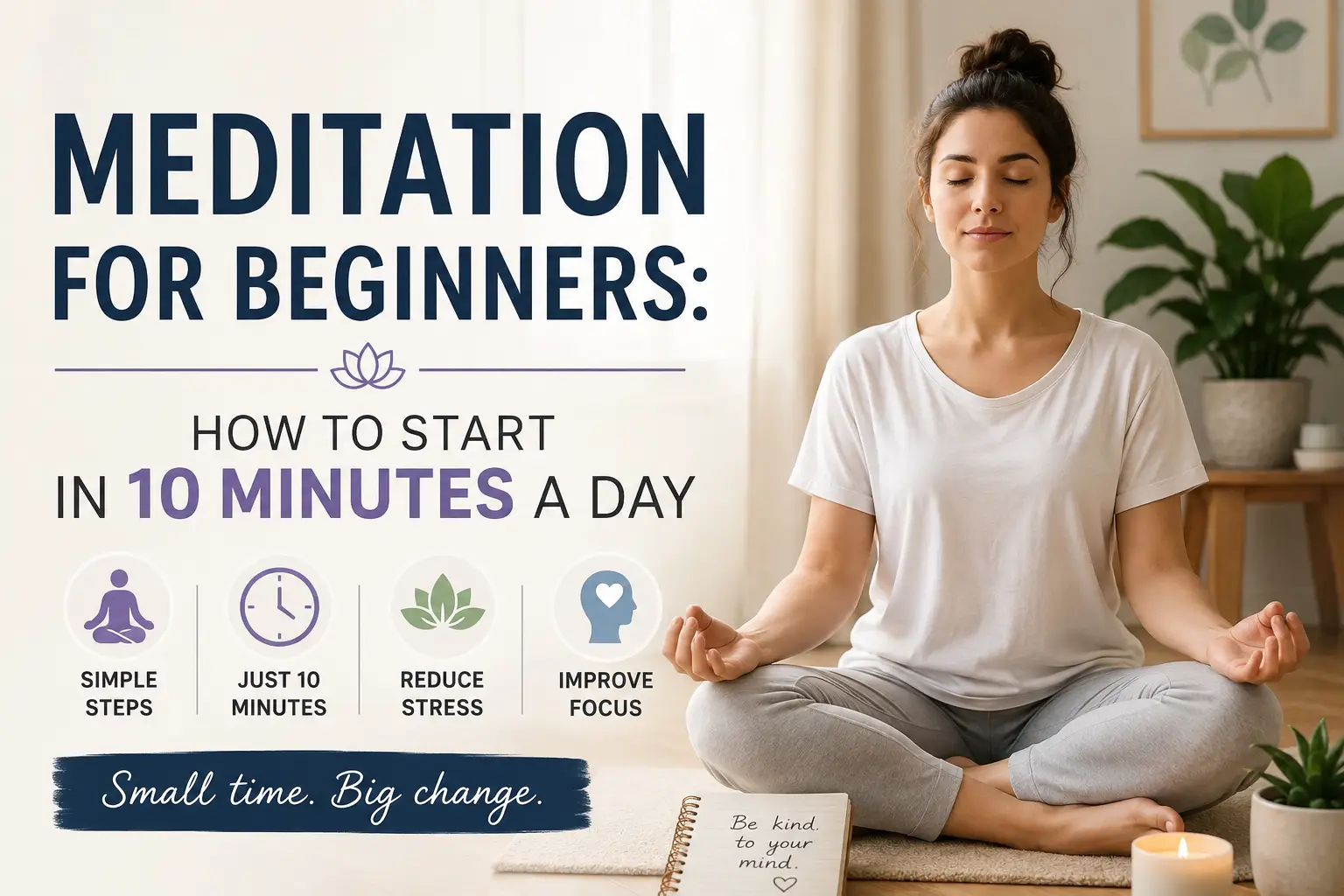
New to meditation? Learn how to start in just 10 minutes a day — 5 beginner techniques with step-by-step instructions, common mistakes to avoid, and what to expect in your first 30 days. No experience or equipment needed.
To start meditating as a beginner, find a quiet spot, sit comfortably, set a timer for 10 minutes, close your eyes, and focus on your natural breathing. When your mind wanders — gently bring it back. That returning of attention is the entire practice. Start today, no equipment or experience needed.
What is Meditation? — The Simplest Explanation
Meditation is the practice of training your attention. Not emptying your mind — that is a myth. Not achieving some mystical state. Simply sitting still and bringing your attention back to a chosen focus (usually the breath) each time it drifts. That act of noticing distraction and returning — repeated hundreds of times over a single session — is what gradually builds a calmer, more focused mind.
India is the birthplace of meditation — the tradition stretches back over 5,000 years through yoga, Buddhist, and Vedic practices. The Ministry of AYUSH recognises meditation and dhyana as core components of India's traditional wellness systems. Modern science, through institutions like AIIMS, NIMHANS, and Harvard Medical School, has studied its effects extensively.
"Meditation is not about becoming a different person or a new person. It is about training in awareness and learning to observe without judgment."
— Widely attributed to mindfulness teaching traditionsHow to Meditate — 5 Steps for Absolute Beginners
Follow these 5 steps exactly. No modifications needed. This works on your first day:
The single most important thing beginners must understand: Meditation success is not measured by how still your mind is. It is measured by how many times you notice distraction and return. A session where your mind wandered 100 times and you returned 100 times is a wildly successful meditation — not a failed one.
5 Meditation Techniques — Choose What Feels Right
There is no single "correct" way to meditate. Different techniques suit different people. Select a technique below to learn how it works:
🌬️ Breath-Focused Meditation
The simplest technique — recommended starting point for all beginners
Focus entirely on the physical sensation of breathing. Don't try to control or change your breath — simply observe it as it is. Notice the air entering your nostrils, the rise of your belly, the gentle pause between inhale and exhale.
- 1Sit, close eyes, take 3 settling breaths
- 2Let breathing become natural — don't control it
- 3Place full attention on belly rising and falling
- 4When mind wanders — notice, and gently return to breath
- 5Continue for 10 minutes
🔍 Body Scan Meditation
Systematic attention through the body — excellent for physical tension and sleep
Move your attention slowly through each part of your body — from the top of your head to the tips of your toes. Notice sensations without trying to change them. Where you find tension, breathe into that area and let it soften.
- 1Lie down or sit comfortably, eyes closed
- 2Start with the top of your head — notice any sensation
- 3Slowly move attention down: forehead, jaw, neck, shoulders...
- 4Continue through chest, belly, hips, legs, feet
- 5Where you find tension — breathe into it and release
🕉️ Mantra Meditation
Repeat a word or phrase silently — an ancient technique from Vedic traditions
Choose a simple word or phrase and repeat it silently with each exhale. Traditional mantras include "Om," "So Hum" (I am that), or "Sat Nam" (truth is my identity). You can also use any word that feels calming — "peace," "calm," or simply counting "one" with each breath.
- 1Choose your mantra — start with "So Hum" if unsure
- 2Close eyes, settle breathing
- 3Silently repeat mantra with each exhale
- 4When thoughts arise — notice, return to mantra
- 5Let the repetition become effortless over time
👁️ Mindfulness Meditation
Open awareness — observe all thoughts, sounds, and sensations without reacting
Instead of focusing on one thing (like breath or mantra), mindfulness meditation asks you to observe everything that arises — thoughts, sounds, physical sensations — without judging, following, or reacting to any of it. You become a neutral observer of your own experience.
- 1Sit, close eyes, settle in with a few breaths
- 2Open your awareness to everything you notice
- 3A thought arises — note "thinking" and let it pass
- 4A sound arises — note "hearing" and let it pass
- 5Nothing to do, nowhere to go — just observe
💛 Loving-Kindness Meditation (Metta)
Generate feelings of warmth and goodwill — toward yourself and others
Loving-kindness meditation involves silently repeating phrases of goodwill — first toward yourself, then expanding outward to loved ones, acquaintances, and eventually all beings. It is particularly helpful for people who are self-critical or going through relationship difficulties.
- 1Close eyes, settle breathing, bring attention to the chest
- 2Silently say: "May I be happy. May I be healthy. May I be at peace."
- 3Think of someone you love — repeat the phrases for them
- 4Think of a neutral person — repeat the phrases for them
- 5Extend to all beings: "May all beings be happy and at peace."
What May Happen in Your First 30 Days
Meditation changes you gradually. Here is what many practitioners report experiencing — individual results vary:
| Period | What You May Experience | What's Normal |
|---|---|---|
| Days 1–7 | Restlessness, boredom, wondering "am I doing this right?" — your mind will feel very noisy | Completely normal. The noise was always there — you're just noticing it for the first time |
| Days 7–14 | Brief moments of stillness between thoughts. May notice subtle changes in how you respond to daily stress | Don't expect transformation yet. The habit itself is the achievement |
| Days 14–21 | Meditation starts feeling natural — less like a task, more like something you look forward to. Focus may feel sharper | Missed days happen — don't quit. Just sit again tomorrow |
| Days 21–30 | Many practitioners report feeling calmer, sleeping better, reacting less to small stresses. The habit is now forming | Benefits are subtle, not dramatic. If you feel even 10% calmer — that's meaningful |
Try this alongside: If you enjoyed the breathing focus technique, try our interactive breathing exercise guide — it includes a live 4-7-8, Box Breathing, and 4-4 Calm tool you can practise right now.
Possible Benefits of Regular Meditation
References: NIMHANS — nimhans.ac.in | AIIMS Wellness Research | Ministry of AYUSH — moayush.gov.in | ICMR — icmr.gov.in
5 Common Beginner Mistakes
When to Consider Guided Classes
Frequently Asked Questions
Ready to Try Guided Meditation in Indore?
Verified instructors · Real reviews · Morning and evening sessions · Book instantly
This article is for general informational purposes only and does not constitute medical or psychological advice. For significant mental health concerns, consult a qualified mental health professional. References: Ministry of AYUSH — moayush.gov.in | NIMHANS — nimhans.ac.in | AIIMS | ICMR — icmr.gov.in | Last updated: June 2026 · © Unisoul Health Pvt. Ltd.