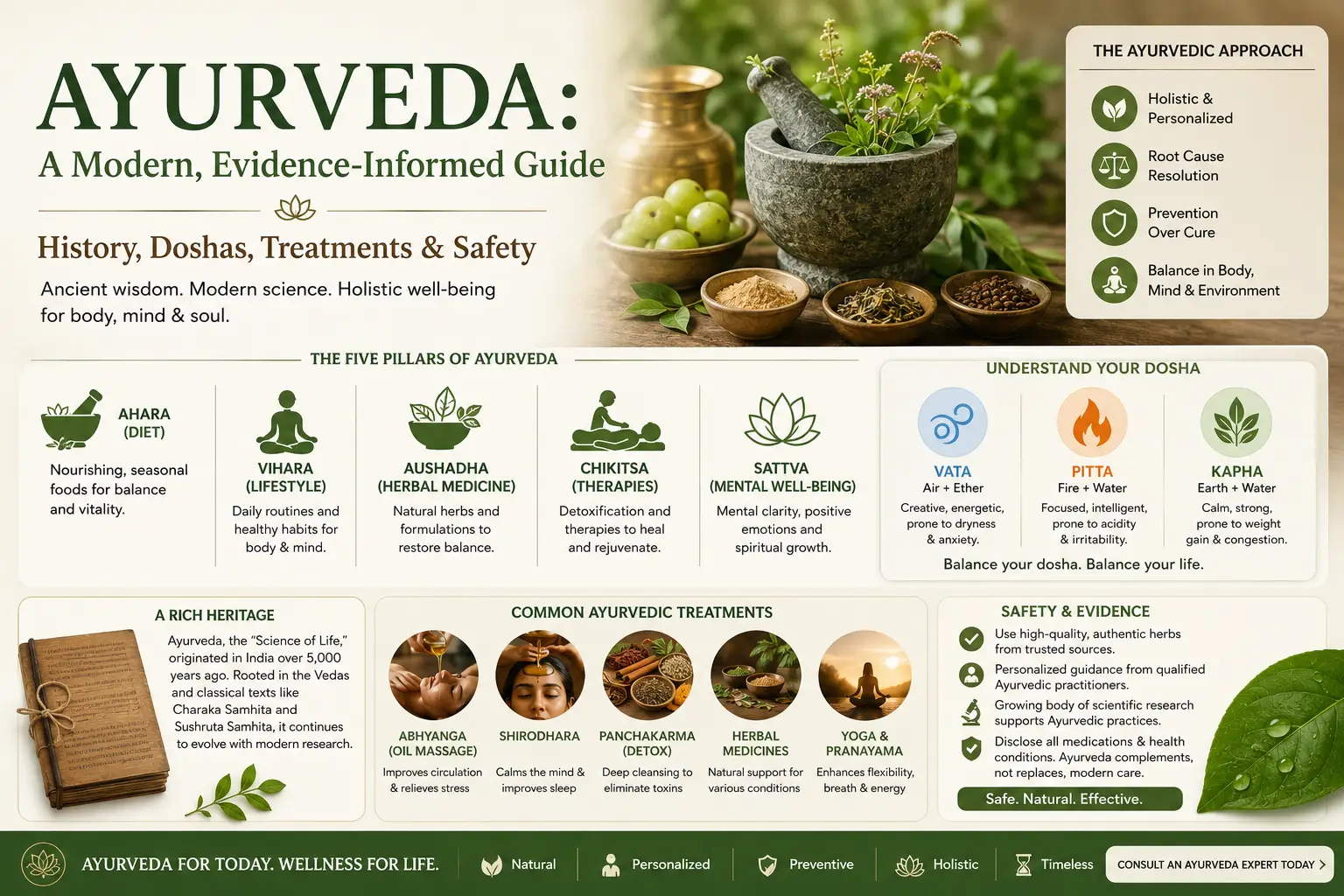
What is Ayurveda? A complete evidence-informed guide covering 5,000-year history, 3 doshas, Panchakarma, common treatments, heavy-metal safety guidelines, and how to find authentic BAMS-verified Ayurvedic practitioners in Indore.
Ayurveda: A Modern, Evidence-Informed Guide — History, Doshas, Treatments | Unisoul Health
Ayurveda is one of the world's oldest holistic wellness systems, originating in India over 5,000 years ago. Recognised by the Ministry of AYUSH, Government of India, it encompasses diet, herbal remedies, yoga, meditation, and detoxification therapies like Panchakarma. This guide covers Ayurveda's history, the three doshas, common treatments, evidence, and critical safety guidelines.
Ayurveda — meaning "the science of life" in Sanskrit — is not merely a medical system. It is a complete framework for living that addresses body, mind, and spirit together. Yet Ayurveda today faces a credibility challenge: most Ayurveda content online is either thin marketing or unscientific. This guide takes a different approach — presenting Ayurveda with respect for its traditions while being honest about what modern evidence supports and where caution is needed.
Medical Disclaimer: This article is for general informational purposes only and does not constitute medical advice. Ayurveda is recognised by the Ministry of AYUSH as a traditional wellness system — it should be viewed as complementary to modern medicine, not a replacement. Always consult a qualified BAMS-degree Ayurvedic physician or your doctor before starting any Ayurvedic treatment, especially if you are pregnant, on medication, or have a diagnosed medical condition. References: Ministry of AYUSH — moayush.gov.in | ICMR — icmr.gov.in | Central Council of Indian Medicine (CCIM)
What is Ayurveda? — A Clear Definition
Ayurveda is a holistic wellness system that originated in India over 5,000 years ago. The word comes from two Sanskrit roots: Ayur (life) and Veda (knowledge or science). At its core, Ayurveda is built on the belief that health is a balance between body, mind, spirit, and environment — and that disease arises when this balance is disrupted.
Unlike modern medicine which typically treats symptoms, Ayurveda's traditional approach focuses on identifying the root cause of imbalance — through diet, lifestyle modification, herbal remedies, detoxification, yoga, and meditation. It is one of the six recognised systems under the Ministry of AYUSH (Ayurveda, Yoga & Naturopathy, Unani, Siddha, Sowa-Rigpa, and Homoeopathy).
"The physician who knows food and uses it wisely — they are the real physician."
— Charaka Samhita, one of the foundational texts of Ayurveda
The History of Ayurveda — A 5,000-Year Journey
5K
3000+ BCE — VEDIC ORIGINS
The earliest references to Ayurvedic healing practices appear in the Rigveda and Atharvaveda — among the world's oldest sacred texts. These describe healing herbs, surgical procedures, and wellness rituals.
CS
600 BCE — CHARAKA SAMHITA
Sage Charaka compiled the Charaka Samhita — the foundational text of Ayurvedic internal medicine. It describes over 600 herbal medicines, dietary guidelines, and the concept of the three doshas.
SS
600 BCE — SUSHRUTA SAMHITA
Sage Sushruta wrote the Sushruta Samhita — the world's earliest surgical text. It describes over 300 surgical procedures including rhinoplasty, cataract surgery, and wound management — many remarkably advanced for their time.
M
MEDIEVAL PERIOD
Ayurveda spread across Asia — influencing traditional Chinese medicine, Tibetan medicine, and Southeast Asian healing systems. Buddhist monks carried Ayurvedic knowledge along the Silk Road.
BR
BRITISH COLONIAL ERA
British colonial rule suppressed Ayurveda in favour of Western medicine. Many Ayurvedic institutions were closed. The tradition survived through family lineages and local practitioners across rural India.
IN
POST-INDEPENDENCE — 1947 ONWARD
Independent India revived Ayurveda — establishing BAMS degree programmes, research councils, and eventually the Ministry of AYUSH in 2014. Today there are over 4 lakh registered Ayurvedic practitioners in India.
GL
2020s — GLOBAL RENAISSANCE
Ayurveda is now a global wellness movement — the Indian government's "Heal in India" initiative, international Ayurveda tourism, and growing scientific research have brought renewed global interest. India introduced the e-Ayush visa for international patients.
References: Ministry of AYUSH — moayush.gov.in | National Institute of Ayurveda, Jaipur | Central Council for Research in Ayurvedic Sciences (CCRAS)
The Three Doshas — Understanding Your Constitution
According to Ayurvedic tradition, every person is born with a unique combination of three fundamental energies called doshas — Vata, Pitta, and Kapha. Your dominant dosha influences your physical characteristics, temperament, digestion, and the types of health imbalances you may be prone to. Select a dosha below to learn more:
🌬️ Vata Dosha — Air + Space
Governs movement, breathing, circulation, and nervous system activity
Vata is the energy of movement. In Ayurvedic tradition, Vata-dominant individuals tend to be creative, energetic, and quick-thinking — but may also be prone to anxiety, restlessness, and irregular digestion when out of balance.
Physical Traits
Light build, dry skin, cold hands and feet, variable appetite
Mental Traits
Creative, quick learner, enthusiastic, may worry easily
Governs digestion, metabolism, body temperature, and intellect
Pitta is the energy of transformation. Pitta-dominant individuals are traditionally described as sharp, focused, and driven — but may be prone to inflammation, acidity, and irritability when the dosha becomes excessive.
Physical Traits
Medium build, warm body, strong appetite, fair or sensitive skin
Mental Traits
Sharp intellect, focused, competitive, decisive
When Balanced
Strong digestion, clear thinking, confident, good leader
Governs structure, stability, lubrication, and immunity
Kapha is the energy of structure and stability. Kapha-dominant individuals tend to be calm, loyal, and physically strong — but may be prone to weight gain, lethargy, and congestion when out of balance.
Strong, stable, compassionate, good memory, steady energy
When Imbalanced
Weight gain, congestion, lethargy, depression, water retention
StructureImmunityStabilityEarth Element
Note: The dosha system is a traditional Ayurvedic classification framework — not a scientifically validated diagnostic tool. It can be a useful lens for understanding personal tendencies, but should not replace medical assessment for any health condition.
What is Panchakarma? — Ayurveda's Signature Detoxification
Panchakarma (meaning "five actions") is Ayurveda's most well-known detoxification and rejuvenation programme. It consists of five therapeutic procedures designed to cleanse the body of accumulated toxins (known as ama in Ayurvedic tradition). Panchakarma should only be administered by a qualified BAMS-degree Ayurvedic physician in a clinical setting.
1
Vamana — Therapeutic Emesis
Controlled therapeutic vomiting to remove excess Kapha accumulation. Used traditionally for respiratory and digestive issues. Must be administered under medical supervision only.
2
Virechana — Purgation Therapy
Controlled cleansing of the lower digestive tract using herbal preparations. Traditionally used for Pitta-related imbalances. Requires careful practitioner supervision.
3
Basti — Medicated Enema
Herbal decoctions or oils administered through the rectum. Considered the most important Panchakarma procedure in classical texts — traditionally used for Vata-related conditions.
4
Nasya — Nasal Administration
Medicated oils or herbal preparations administered through the nasal passages. Traditionally used for conditions above the collarbone — sinusitis, headaches, and neurological conditions.
5
Raktamokshana — Bloodletting
Traditional blood purification technique — rarely practised in modern settings. Modern Ayurvedic centres often replace this with herbal blood-purification therapies.
Safety Warning — Panchakarma: Panchakarma is an intensive clinical procedure. It must NEVER be attempted at home or by unqualified practitioners. Always verify that your practitioner holds a BAMS degree and the centre is registered with the state AYUSH department. Pregnant women, children, elderly patients, and people with certain medical conditions should not undergo Panchakarma without explicit medical clearance.
Common Ayurvedic Treatments and Therapies
🫒
Abhyanga — Full Body Oil Massage
Warm herbal oil massage performed in specific strokes. Traditionally believed to support circulation, nourish tissues, and calm the nervous system. One of the most popular Ayurvedic treatments worldwide.
💧
Shirodhara — Oil Pouring on Forehead
A continuous stream of warm herbal oil poured on the forehead. Traditionally used for stress, mental fatigue, and sleep difficulties. Considered deeply calming by practitioners.
🌿
Kati Basti — Lower Back Treatment
Warm medicated oil held in a dough ring on the lower back. Traditionally used for lower back pain and stiffness. One of the most requested Ayurvedic treatments for desk workers.
🦵
Janu Basti — Knee Treatment
Warm medicated oil held in a dough ring around the knee joint. Traditionally recommended for knee stiffness and joint discomfort. Often sought by older adults.
🌶️
Pizhichil — Oil Bath Therapy
Warm medicated oil poured continuously over the body while being gently massaged. A luxury Ayurvedic treatment traditionally used for rejuvenation and nervous system support.
🧴
Udvartana — Herbal Powder Massage
Dry herbal powder rubbed on the body in upward strokes. Traditionally believed to support circulation and is commonly used in Ayurvedic weight-management programmes.
What Does Modern Evidence Say About Ayurveda?
Ayurveda occupies a complex position in the evidence landscape. Some practices have genuine research backing, while others rely primarily on traditional knowledge. Here is an honest assessment — based on publicly available research from AIIMS, ICMR, CCRAS, and international databases:
Practice / Herb
Research Status
Evidence Level
Ashwagandha (Withania somnifera)
Multiple studies show possible benefits for stress, anxiety. Active research ongoing
Moderate — promising
Turmeric / Curcumin
Extensively studied for anti-inflammatory properties. Bioavailability is a challenge
Moderate to strong (for curcumin specifically)
Triphala
Some studies suggest digestive and antioxidant properties. More clinical trials needed
Emerging — limited
Yoga (as part of Ayurveda)
Strong research base — AIIMS, NIMHANS, and WHO recognise its wellness benefits
Strong for stress, flexibility, mental wellness
Panchakarma
Limited high-quality clinical trials. Pilot studies show potential for certain conditions
Limited — needs more research
Abhyanga (Oil Massage)
Limited clinical data. Widely practised and subjectively reported as beneficial
Low clinical, high experiential
Dosha Classification
Traditional framework — not validated as a diagnostic tool by modern clinical science
Traditional only — not clinical
The honest position: Ayurveda contains genuine therapeutic wisdom refined over millennia, alongside practices that require modern scientific validation. The responsible approach is to embrace what research supports, remain open to what is being studied, and be cautious about unsupported claims.
While Ayurveda is generally considered safe when practised by qualified physicians using standardised preparations, there are real safety concerns that every consumer should be aware of:
Critical Safety Alert — Heavy Metals in Ayurvedic Products: Some traditional Ayurvedic preparations — particularly rasa shastra (metallic/mineral-based) formulations — have been found to contain unsafe levels of lead, mercury, and arsenic. Multiple international studies, including a widely-cited 2004 JAMA study, found that approximately 20% of Ayurvedic products purchased online contained detectable heavy metals. Always verify that products carry the AYUSH manufacturing licence, GMP certification, and batch-tested heavy-metal clearance from an accredited laboratory. Never purchase Ayurvedic medicines from unverified online sellers.
✅Verify practitioner credentials: A qualified Ayurvedic doctor holds a BAMS (Bachelor of Ayurvedic Medicine and Surgery) degree — a 5.5-year programme from a CCIM-recognised institution. Always ask for credentials.
✅Check product certifications: Look for the AYUSH manufacturing licence number, GMP certification mark, and batch number on all Ayurvedic products. Avoid products without these markings.
✅Inform your doctor: Always tell your allopathic doctor if you are taking Ayurvedic medicines — drug interactions are possible and not always well-documented.
✅Avoid self-medication: Ayurvedic herbs can be powerful. Ashwagandha, shatavari, guggul, and others have real physiological effects — they should be taken under practitioner guidance, not based on internet advice.
✅Pregnancy caution: Many Ayurvedic herbs and treatments are contraindicated during pregnancy. Never take Ayurvedic preparations during pregnancy without explicit clearance from both your Ayurvedic physician and your obstetrician.
✅Children and elderly: Dosages and treatments for children and elderly patients differ significantly from adults. Paediatric and geriatric Ayurveda requires specialist training — do not apply general adult protocols.
How to Choose an Authentic Ayurvedic Practitioner
1
Check for BAMS degree: A qualified Ayurvedic physician completes 5.5 years of education including 1 year of internship. The degree is awarded by CCIM-recognised universities. This is the minimum standard — no exceptions.
2
Verify state registration: Every practising Ayurvedic doctor must be registered with their state AYUSH board. You can verify registration through the state AYUSH department's website or office.
3
Ask about the centre's licence: Any clinic or centre offering Panchakarma or Ayurvedic treatments must have a valid licence from the state health department. Ask to see it — legitimate centres display it prominently.
4
Read patient reviews: Genuine patient reviews reveal more than credentials alone. On Unisoul Health, only verified patients who actually attended can leave reviews — ensuring authentic feedback.
5
Beware of miracle claims: Any practitioner or product claiming to "cure" cancer, diabetes, or other serious diseases should be approached with extreme caution. Responsible Ayurvedic physicians present their treatments as complementary — not curative for serious diseases.
Ayurveda + Modern Medicine — The Complementary Approach
The most responsible and effective approach to Ayurveda in 2026 is an integrative one — using Ayurveda alongside modern medicine rather than as a replacement. The Ministry of AYUSH actively promotes this model through its AYUSH Health & Wellness Centres (Ayushman Arogya Mandirs) — over 1,78,154 centres established across India by 2025.
Where Ayurveda May Add Value
Preventive wellness and daily routine (dinacharya), dietary guidance based on constitution, stress management through meditation and yoga, digestive wellness, post-recovery rejuvenation, skin and hair care using herbal preparations, complementary support alongside medical treatment.
Where Modern Medicine Leads
Emergency medicine, surgical interventions, infectious diseases, cancer treatment, diagnostic imaging and lab testing, acute trauma care, organ transplants, pharmaceutical management of chronic conditions.
The wise approach: use each system where it is strongest. Ayurveda for prevention, wellness, and complementary support — modern medicine for diagnosis, emergencies, and clinical treatment of disease.
Frequently Asked Questions
What is Ayurveda?
Ayurveda is one of the world's oldest holistic wellness systems, originating in India over 5,000 years ago. It encompasses diet, herbal remedies, yoga, meditation, and detoxification therapies. It is recognised by the Ministry of AYUSH, Government of India.
What are the 3 doshas in Ayurveda?
The three doshas are Vata (air + space — governs movement), Pitta (fire + water — governs digestion and metabolism), and Kapha (earth + water — governs structure and stability). Every person is said to have a unique combination of all three.
Is Ayurveda scientifically proven?
Some Ayurvedic practices and herbs (like ashwagandha and turmeric) have been studied with promising results. Others lack sufficient clinical evidence. Ayurveda should be viewed as complementary — not a replacement for modern medicine. Research is ongoing at AIIMS, CCRAS, and internationally.
Is Ayurvedic medicine safe?
When practised by qualified BAMS practitioners using standardised preparations — generally yes. However, some products (particularly metallic preparations) have been found to contain heavy metals. Always verify credentials, check product certifications, and inform your allopathic doctor about any Ayurvedic medicines you take.
What is Panchakarma?
Panchakarma is Ayurveda's five-procedure detoxification and rejuvenation programme. It should only be administered by a qualified BAMS physician in a registered clinical setting — never attempted at home.
Where can I find authentic Ayurvedic treatment in Indore?
Unisoul Health lists verified Ayurvedic practitioners in Indore with BAMS verification, real patient reviews, transparent pricing, and instant booking. Visit unisoulhealth.com or call +91 8085509065.
At UniSoul Wellness Hub, we are dedicated to providing expert guidance on holistic health and well-being. Our team of professionals shares insights to help you achieve balance in mind, body, and spirit.