Discover 8 effective exercises for lower back pain relief you can do at home. Step-by-step instructions with safety guidelines. Know when exercises help and when you need a physiotherapist. Expert-reviewed guide by Unisoul Health.
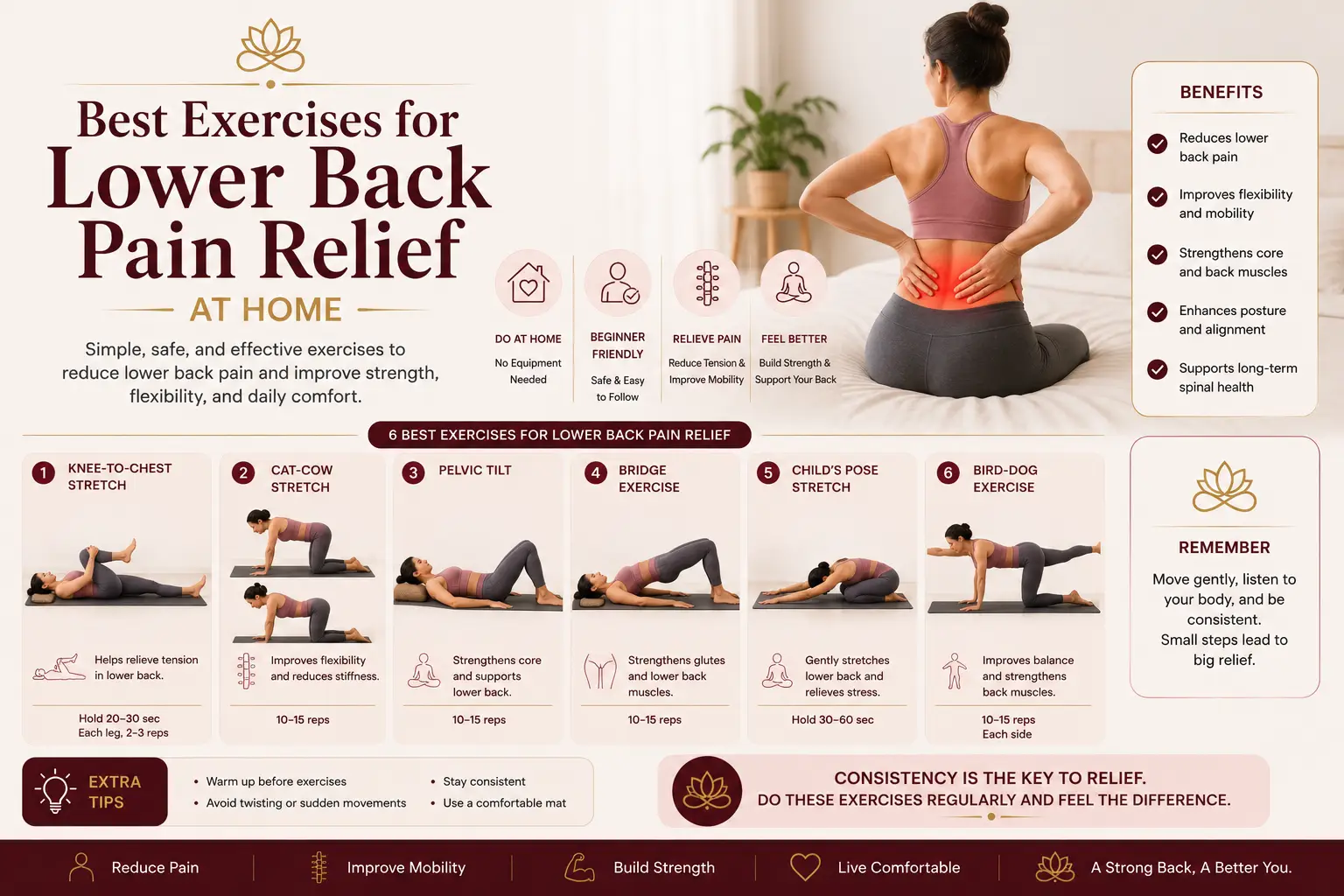
The best home exercises for lower back pain include knee-to-chest stretches, cat-cow movements, pelvic tilts, bird-dog, child pose, bridges, seated spinal twist, and hamstring stretches. These may help relieve mild, non-specific lower back discomfort when practised regularly with correct form. For chronic or severe pain, consult a qualified physiotherapist.
Lower Back Pain in India — The Scale of the Problem
According to the Indian Orthopaedic Association, lower back pain is the single most common musculoskeletal complaint in clinical practice across India. The rise of sedentary desk jobs, increasing screen time, and lack of regular physical activity have made this an epidemic — affecting not just older adults but increasingly young professionals in their twenties and thirties.
The good news is that for non-specific lower back pain — the kind caused by poor posture, prolonged sitting, or general muscle weakness — regular gentle exercise is one of the most widely recommended approaches by physiotherapists and medical bodies worldwide, including the Indian Association of Physiotherapists (IAP) and ICMR.
References: Indian Orthopaedic Association | IAP — physiotherapy.in | ICMR Physical Activity Guidelines
Who Should (and Should NOT) Do These Exercises
8 Best Exercises for Lower Back Pain Relief — Interactive Guide
Select any exercise below to see full step-by-step instructions, recommended repetitions, and safety notes:
🦵 Knee-to-Chest Stretch
Beginner · Gentle stretch · Targets lower back and glutes
- 1Lie on your back on a firm surface with knees bent and feet flat on the floor
- 2Slowly bring your right knee toward your chest using both hands behind the thigh or on top of the shin
- 3Keep your left foot flat on the floor and your lower back pressed gently against the surface
- 4Hold the stretch for 20 to 30 seconds — breathe deeply and feel the gentle stretch in your lower back
- 5Slowly lower the right leg back to starting position
- 6Repeat with the left leg. Do 3 repetitions on each side
Stop if you feel sharp pain. Do not pull knee aggressively. Avoid if you have hip replacement or knee surgery recovery.
🐱 Cat-Cow Stretch (Marjaryasana)
Beginner · Spinal mobility · Traditional yoga movement
- 1Start on hands and knees — wrists directly below shoulders, knees below hips
- 2Inhale — drop your belly toward the floor, lift your chest and tailbone upward (Cow position)
- 3Exhale — round your spine toward the ceiling, tuck your chin and tailbone downward (Cat position)
- 4Move slowly — let each movement flow with your breath. Do not rush
- 5Repeat 8 to 10 times. The movement should feel gentle and rhythmic
One of the most widely recommended warm-up exercises by physiotherapists. Recognised by AYUSH as part of yogic wellness tradition.
🔄 Pelvic Tilts
Beginner · Core activation · Foundation exercise
- 1Lie on your back with knees bent, feet flat on the floor, arms by your sides
- 2Gently flatten your lower back against the floor by tightening your abdominal muscles
- 3Your pelvis will tilt slightly upward — this is the pelvic tilt
- 4Hold this position for 5 seconds while breathing normally
- 5Release and return to the starting position. Repeat 10 to 15 times
One of the first exercises physiotherapists prescribe for lower back rehabilitation. Very safe for most people when done gently.
🐦 Bird-Dog Exercise
Beginner–Intermediate · Core stability and balance
- 1Start on hands and knees in a stable tabletop position
- 2Simultaneously extend your right arm forward and your left leg backward
- 3Keep your back flat — do not let your hips rotate or your back arch
- 4Hold for 5 seconds. Your arm, spine, and leg should form one straight line
- 5Return to starting position. Repeat with left arm and right leg
- 6Do 8 to 10 repetitions on each side. Focus on stability, not speed
Excellent for building core stability that protects the lower back. Move slowly and maintain control throughout.
🧒 Child Pose (Balasana)
All levels · Rest and recovery · Traditional yoga pose
- 1Kneel on the floor, sitting back on your heels with toes together
- 2Extend your arms forward on the floor, lowering your forehead toward the ground
- 3Let your entire back round gently and relax with each exhale
- 4Breathe deeply — try to direct each breath into the lower back area
- 5Hold for 30 to 60 seconds. This is a resting pose — no effort required
A resting pose that gently stretches the lower back. Recognised by AYUSH as part of yogic tradition. Avoid if you have knee issues.
🌉 Bridge Exercise (Setu Bandhasana)
Beginner · Glute and core strengthening
- 1Lie on your back with knees bent, feet flat on floor hip-width apart
- 2Press through your heels and lift your hips off the floor
- 3Squeeze your glutes at the top — your body should form a straight line from knees to shoulders
- 4Hold for 5 seconds at the top position
- 5Lower slowly back to the floor. Repeat 10 to 15 times
Strong glutes are essential for lower back support. Weak glutes are one of the most common causes of non-specific lower back pain.
🔁 Seated Spinal Twist
Beginner · Spinal rotation and flexibility
- 1Sit on the floor with both legs extended in front of you
- 2Bend your right knee and cross your right foot over your left leg
- 3Place your left elbow on the outside of your right knee
- 4Gently twist your torso to the right — look over your right shoulder
- 5Hold for 20 to 30 seconds. Breathe deeply — deepen the twist slightly on each exhale
- 6Release and repeat on the other side
Do not force the twist. The rotation should be gentle and controlled. Stop if you feel any sharp pain.
🦿 Supine Hamstring Stretch
Beginner · Hamstring flexibility · Reduces lower back tension
- 1Lie on your back with both knees bent, feet flat on floor
- 2Raise your right leg upward — keep the knee slightly bent if needed
- 3Loop a towel around the ball of your right foot, or hold behind the thigh with both hands
- 4Gently pull the leg toward you until you feel a comfortable stretch in the back of the thigh
- 5Hold for 20 to 30 seconds while breathing normally
- 6Lower the leg slowly and repeat with the left leg. Do 2 to 3 rounds each side
Tight hamstrings are a common contributor to lower back pain. Regular hamstring stretching may reduce strain on the lower back over time.
Why These Exercises May Help Your Lower Back
References: Indian Association of Physiotherapists (IAP) | ICMR Physical Activity Guidelines | International evidence supports gentle exercise as a first-line approach for non-specific lower back pain — presented as general wellness information, not medical advice.
Suggested Daily Routine — 15 Minutes
Follow this sequence once daily for a complete 15-minute lower back wellness routine. Morning or evening — pick a time you can maintain consistently:
| Order | Exercise | Duration/Reps | Purpose |
|---|---|---|---|
| 1 | Cat-Cow Stretch | 8 rounds | Warm up the spine |
| 2 | Pelvic Tilts | 10 reps | Activate core |
| 3 | Knee-to-Chest | 3 each side | Stretch lower back |
| 4 | Bird-Dog | 8 each side | Core stability |
| 5 | Bridge | 10 reps | Strengthen glutes |
| 6 | Seated Spinal Twist | 20 sec each | Spinal rotation |
| 7 | Hamstring Stretch | 20 sec each | Release tight hamstrings |
| 8 | Child Pose | 60 sec | Rest and recovery |
5 Common Mistakes to Avoid
When Home Exercises Are Not Enough — What to Do Next
If you have been doing these exercises consistently for 2 to 4 weeks and your pain has not improved — or has worsened — it is time to see a qualified physiotherapist. A physiotherapist can assess your specific condition, identify the root cause, and create a personalised rehabilitation plan that may include manual therapy, electrotherapy, and targeted strengthening exercises.
On Unisoul Health, you can find verified physiotherapists in Indore with real patient reviews, transparent pricing, and instant booking — no phone calls needed.
Frequently Asked Questions
Still in Pain? Book a Physiotherapist in Indore
Verified physiotherapists · Real reviews · Transparent pricing · Book instantly — no calls needed
This article is for general informational purposes only and does not constitute medical advice, diagnosis, or treatment. All exercises described are for mild, non-specific lower back discomfort only. For any persistent, severe, or worsening pain — consult a qualified physiotherapist or doctor before exercising. References: Indian Association of Physiotherapists — physiotherapy.in | ICMR — icmr.gov.in | Ministry of AYUSH — moayush.gov.in | Last updated: June 2026 · © Unisoul Health Pvt. Ltd.